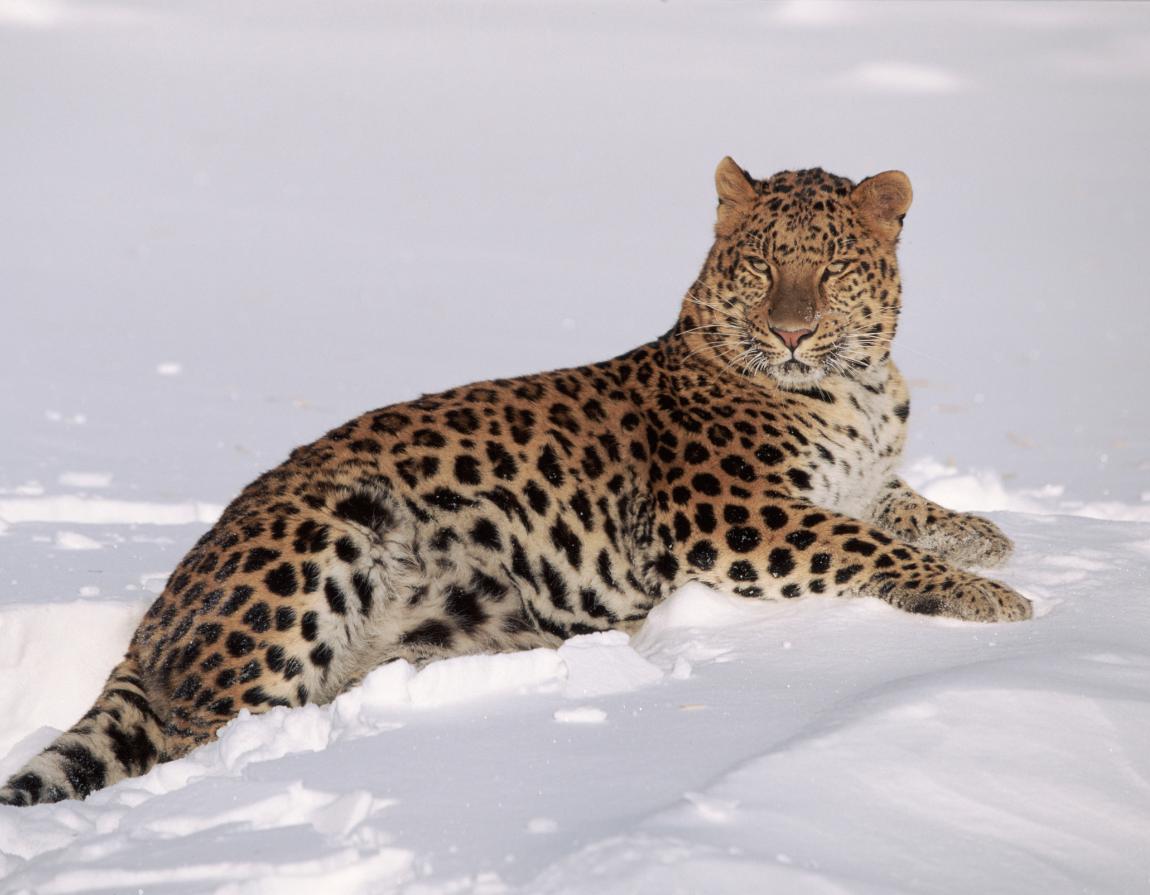
Few big cats are as difficult to find as the Amur leopard. Built for freezing forests on the Russian-Chinese border, this solitary predator nearly vanished from the wild. Today it is slowly returning—but its future is still far from secure.
The Leopard That Disappears Into Winter
A leopard is not the animal most people imagine when they picture a frozen forest.
We usually associate leopards with warm landscapes, rocky mountains, grasslands, or the savannas of Africa.
But at the northeastern edge of Asia, a very different leopard lives among snow-covered forests.
The Amur leopard has adapted to one of the coldest environments occupied by any leopard.
Its home lies in the forested region of the Russian Far East and northeastern China, where winters can be brutally cold and snow can cover the ground for long periods.
The leopard's coat becomes thicker during winter.
Its fur is pale compared with many other leopard subspecies.
Its legs are relatively long.
Its paws help it move through snowy terrain.
And its dark rosettes break up its outline against the complicated background of branches, rocks, shadows, and snow.
When this leopard stops moving in a winter forest, it can almost disappear.
That ability is more than beautiful camouflage.
For a solitary predator, being difficult to detect can mean the difference between catching prey and going hungry.
The Amur leopard has become a specialist in disappearing.
And for a long time, it almost disappeared completely.
A Leopard Built for the Cold
The Amur leopard is a subspecies of leopard scientifically known as *Panthera pardus orientalis*.
Unlike many leopards that live in warmer climates, it survives in temperate forests where winter temperatures can fall dramatically.
Its winter coat can grow to several centimetres in length, providing insulation against the cold. WWF notes that the coat can reach around 7 centimetres during winter. :contentReference[oaicite:1]{index=1}
Its body also has features suited to this environment.
The coat is relatively pale.
The rosettes are large, dark, and widely spaced.
The thick fur provides protection.
And the leopard's powerful limbs allow it to move across difficult terrain while pursuing prey.
It may look like a familiar leopard wearing a winter coat.
But its entire lifestyle has been shaped by the forest.
The Ghost of the Forest Has a Territory
Amur leopards are solitary animals.
They don't normally travel around in large groups.
A leopard needs enough territory to find prey, shelter, and suitable places to raise cubs.
That makes habitat particularly important for this subspecies.
A forest isn't simply a backdrop.
It is the leopard's hunting ground, hiding place, travel route, and nursery.
The remaining population is concentrated in the transboundary region of the Russian Far East and northeastern China. WWF describes the Amur-Heilong landscape as an important habitat for the species. :contentReference[oaicite:2]{index=2}
The border between countries means that conservation cannot stop at a political boundary.
A leopard doesn't know where Russia ends and China begins.
It simply follows the forest.
It Can Move Faster Than You Think
The Amur leopard may look like a slow-moving animal when photographed sitting in snow.
That impression is misleading.
Like other leopards, it is capable of sudden bursts of speed.
WWF reports that Amur leopards can reach speeds of up to 37 miles per hour and can leap more than 19 feet horizontally and up to 10 feet vertically. :contentReference[oaicite:3]{index=3}
But speed isn't necessarily the main advantage of a leopard.
Stealth is often more important.
A leopard can spend much of its time moving quietly through vegetation and watching.
It doesn't need to chase every animal it encounters.
It needs to choose the right moment.
Then the quiet forest can suddenly become very loud.
The Hunt Begins With Waiting
The Amur leopard feeds on animals such as roe deer, sika deer, and hare.
These prey species are essential to the leopard's survival.
A leopard may be powerful enough to kill a deer, but strength doesn't create food.
There must be enough prey in the forest.
This creates a chain of dependence.
Healthy forests support prey.
Healthy prey populations support leopards.
If people hunt too many deer and other prey species, the leopard's food supply can shrink.
WWF identifies prey scarcity as one of the major threats facing the species. :contentReference[oaicite:4]{index=4}
This is why protecting a predator often means protecting animals that humans might never think about when discussing that predator.
Saving the leopard requires saving its dinner.
A Kill Is Too Valuable to Waste
Leopards have another interesting hunting habit.
They can carry and hide unfinished kills so that other predators do not steal them.
That behaviour becomes especially useful in a landscape where finding the next meal may require significant effort. WWF notes that Amur leopards carry and hide unfinished kills. :contentReference[oaicite:5]{index=5}
Imagine spending hours moving through snow searching for prey.
Then finally making a successful kill.
Leaving it exposed could attract another predator.
Instead, the leopard can drag part of its meal to a safer location.
It is a simple behaviour, but it reveals something important about life in a harsh environment.
Food cannot be taken for granted.
Every successful hunt matters.
The Forest Once Held More of Them
The Amur leopard was once found across a much larger part of northeastern Asia.
Historical populations extended through areas of northeastern China, the Russian Far East, and the Korean Peninsula.
Over time, however, habitat loss, hunting, poaching, and declines in prey populations pushed the animal toward extinction.
By the beginning of the 21st century, the situation was frightening.
WWF describes the Amur leopard as the world's rarest big cat and notes that the Russian population had fallen to roughly 27–32 animals before beginning to recover. :contentReference[oaicite:6]{index=6}
A big cat reduced to a few dozen individuals is not simply rare.
It is dangerously close to disappearing.
Then the Numbers Started Moving
The Amur leopard's story isn't only a story of decline.
It is also a story of one of conservation's more encouraging recoveries.
WWF reports that the number of Amur leopards in Russia increased from approximately 27–32 animals to 70–75 over a 15-year period, with additional animals recorded in China's bordering provinces. :contentReference[oaicite:7]{index=7}
Other monitoring has reported even higher numbers within protected areas.
In 2024, Russian authorities reported 129 adult Amur leopards in Land of the Leopard National Park, along with at least 14 cubs. :contentReference[oaicite:8]{index=8}
The exact number depends on the survey area, year, and counting method.
But the overall direction is important.
The species has not simply vanished.
It has responded to protection.
The Place Called Land of the Leopard
One of the most important developments in the leopard's recovery came in 2012.
Russia established Land of the Leopard National Park in the Russian Far East.
WWF says the protected area covers nearly 650,000 acres and includes the leopard's breeding areas and a large portion of its remaining habitat. :contentReference[oaicite:9]{index=9}
That changes the leopard's situation dramatically.
Instead of trying to survive in scattered pieces of unprotected forest, a substantial portion of its habitat receives formal protection.
The park also protects other wildlife, including Amur tigers.
Protecting the leopard therefore protects an entire forest ecosystem.
The leopard became a reason to defend the forest.
And the forest became the leopard's safest refuge.
Camera Traps Became the Eyes of the Forest
Finding an Amur leopard by walking through the forest is extremely difficult.
The animal is solitary.
Its habitat is enormous.
And it is exceptionally good at avoiding people.
Camera traps solve part of the problem.
Researchers can place cameras along trails and other locations where animals are likely to pass.
When a leopard walks past, the camera records it.
The rosette patterns on a leopard's coat can help researchers identify individual animals.
Suddenly, a forest that appears empty becomes full of information.
A single photograph can reveal that a particular leopard is alive.
A series of photographs can reveal movement.
Over time, thousands of images can help scientists estimate population size and understand how animals use the landscape.
The ghost can finally be counted.
The Snow Makes the Leopard Easier to Follow
Winter also gives researchers another advantage.
Tracks in snow can reveal where an animal has travelled.
A leopard that remains almost invisible among trees can leave an obvious trail behind it.
Footprints can reveal direction.
They can show movement through a territory.
They can help researchers identify where animals are active.
The same snow that makes life difficult for the leopard can therefore become a record of its movements.
For a species this rare, every clue matters.
The Leopard's Future Depends on Prey
Protecting the forest alone isn't enough.
Imagine creating a huge protected area but allowing prey populations to collapse.
The leopard would have plenty of trees.
But it wouldn't have enough food.
This is why conservation programs also focus on prey species such as roe deer, sika deer, and wild boar.
WWF reports efforts to increase prey populations and restore prey in suitable areas. :contentReference[oaicite:10]{index=10}
The logic is simple.
More healthy prey means more food.
More food means leopards can survive and reproduce.
And a larger leopard population is more capable of expanding into suitable habitat.
Conservation is therefore not a single action.
It is a chain.
Break one link and the whole system becomes weaker.
The Problem of a Small Population
Even when the number of animals begins to increase, a species can still face serious biological problems when its population has been reduced to a very small size.
Amur leopards have experienced severe historical population decline.
Researchers have therefore studied their genetic diversity and the effects of isolation.
A scientific study of the remaining population highlighted the importance of understanding genetic diversity and maintaining connectivity between suitable habitats. :contentReference[oaicite:11]{index=11}
This is one reason expanding the population's range matters.
The goal isn't simply to count more leopards inside one protected park.
The long-term goal is to create a larger, healthier population spread across connected habitats.
The Road Back Is Not Straight
A species can recover and still remain endangered.
That distinction is important.
The Amur leopard has shown that conservation can work.
But it is still classified as critically endangered by WWF's species information, and the remaining population is extremely small compared with historical levels. :contentReference[oaicite:12]{index=12}
Habitat fragmentation remains a concern.
Prey scarcity remains a concern.
Illegal wildlife trade remains a concern.
Human infrastructure can create barriers between forest areas.
And climate and landscape changes may alter the environment on which the leopard depends.
A recovery from a few dozen animals is remarkable.
But it is not the same thing as being safe.
A Leopard Can Cross a Border
There is something almost poetic about the Amur leopard's range.
The animal doesn't recognize international borders.
A forest corridor can run from one country into another.
A leopard can cross that invisible line without knowing that humans have drawn it there.
This makes international cooperation essential.
Researchers have highlighted the importance of maintaining forest corridors connecting habitats in Russia and China and reducing human barriers to movement. :contentReference[oaicite:13]{index=13}
If conservation happens on only one side of the border, the leopard can still face problems on the other.
The animal's map is the forest.
The conservation map has to catch up.
Cubs Are the Future
Amur leopard mothers can have one to four cubs.
The cubs remain dependent on their mother for a significant period.
WWF reports that cubs are generally weaned at around three months and may remain with their mother until roughly one and a half to two years of age. :contentReference[oaicite:14]{index=14}
That long period matters.
Raising a cub isn't simply about feeding it.
The young leopard must eventually learn how to survive.
It needs to understand the forest.
It must learn to hunt.
It must become capable of living alone.
And eventually, it has to find territory of its own.
Every successful cub represents another chance for this rare population to expand.
The Comeback Needs Space
The most exciting possibility for the Amur leopard is not merely that more individuals will survive.
It is that they will begin occupying more of their former range.
A recovering population needs somewhere to go.
If every suitable forest is isolated, the population can become trapped inside small pockets.
If corridors remain connected, young animals can disperse.
They can find new territories.
They can encounter potential mates.
New populations can eventually form.
A leopard's comeback therefore depends on geography.
The question isn't simply:
“How many leopards are alive?”
It is also:
“Where can the next generation live?”
Why the Amur Leopard Matters
The Amur leopard is obviously important because it is a unique animal.
It is found nowhere else naturally.
It represents a rare branch of the leopard family.
But its importance goes beyond the species itself.
The forests that support Amur leopards also support deer, wild boar, birds, smaller mammals, plants, and other predators.
Protecting the leopard means protecting habitat large enough for many other species.
The leopard becomes an umbrella.
Protect the space required by the leopard, and many other animals benefit from the same protection.
The Ghost Is Still Here
For years, the easiest story to tell about the Amur leopard would have been a tragic one.
A beautiful animal.
A disappearing forest.
A population falling toward zero.
But that isn't the complete story anymore.
There are still Amur leopards moving through the snow.
There are cubs being born.
Camera traps are still finding individuals.
Protected forests are still expanding the possibilities for recovery.
And conservationists are still working to reconnect the landscapes the species needs.
The leopard has not won.
But it has not disappeared either.
That difference matters.
Frequently Asked Questions
What is the Amur leopard?
The Amur leopard is a critically endangered leopard subspecies, scientifically known as *Panthera pardus orientalis*, adapted to temperate forests in the Russian Far East and northeastern China. :contentReference[oaicite:15]{index=15}
Where does the Amur leopard live?
Its remaining range is concentrated around the Russian Far East and adjacent parts of northeastern China. :contentReference[oaicite:16]{index=16}
Why is it called the Ghost of the Snow Forest?
It is not an official scientific name. The nickname reflects the leopard's rarity, solitary lifestyle, camouflage, and ability to move almost invisibly through snowy forests.
How fast can an Amur leopard run?
WWF reports speeds of up to 37 miles per hour. :contentReference[oaicite:17]{index=17}
What does the Amur leopard eat?
Its prey includes roe deer, sika deer, hare, and other animals available in its forest habitat. :contentReference[oaicite:18]{index=18}
Why did the Amur leopard become endangered?
Major threats include poaching, illegal wildlife trade, habitat loss, and declines in prey populations. :contentReference[oaicite:19]{index=19}
How many Amur leopards are left?
The number varies according to the survey area and year. WWF describes the species as having a population of more than 84 individuals, while more recent regional monitoring has recorded substantially higher numbers in protected areas. :contentReference[oaicite:20]{index=20}
Can the Amur leopard recover?
Yes. Its population has increased substantially from its historic low following stronger habitat protection, anti-poaching work, prey recovery, and conservation programs. However, the species remains critically endangered. :contentReference[oaicite:21]{index=21}
The Last Tracks in the Snow
Somewhere in the forests of the Russian Far East, a leopard may be walking through fresh snow.
There may be no human nearby.
No tourist.
No photographer.
No researcher.
Just footprints appearing one after another.
The leopard moves between trees, its pale winter coat blending into the cold landscape.
It is searching for prey.
It is crossing its territory.
Perhaps it is carrying food back toward a hidden den.
Perhaps a young leopard is following its mother.
Or perhaps it is simply moving through a forest that its species almost lost forever.
That is what makes the Amur leopard's story so powerful.
It isn't just a story about an animal that became rare.
It is a story about an animal that came dangerously close to disappearing—and then began finding its way back.
The forest is still cold.
The winters are still harsh.
The leopard is still difficult to see.
But the tracks are there.
And as long as those tracks continue appearing in the snow, the ghost of the forest is still alive.
SOURCES FOR ARTICLE REFERENCE
WWF — Amur Leopard Facts & Conservation
WWF — Amur Leopard Facts
WWF — Amur-Heilong Ecosystem
PLOS ONE — Amur Leopard Population Genetics

0 Comments