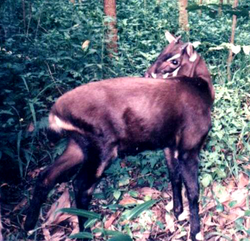
Discovered by scientists only in 1992, the saola is one of the most mysterious large mammals on Earth. With long parallel horns, white facial markings, and an almost complete absence from human observation, this critically endangered animal has become known as the Asian unicorn.
A Face That Shouldn't Have Been New to Science
In 1992, scientists exploring the forests of Vietnam found something they weren't expecting.
It wasn't a new frog.
It wasn't an unknown bird.
It wasn't a tiny insect hiding under a leaf.
It was a large mammal.
And it had horns.
The animal had been known locally, but scientists had never formally described it. Its skull, discovered during a joint survey by Vietnam's Ministry of Forestry and WWF, revealed an animal so unusual that researchers realized they were looking at something completely new to science.
The animal was named the saola.
Its scientific name is *Pseudoryx nghetinhensis*.
And almost immediately, it earned a nickname that sounds more appropriate for mythology than zoology:
The Asian unicorn.
More than three decades later, scientists still know remarkably little about it.
That may be the strangest part of the story.
We discovered the saola in 1992.
And yet, even today, researchers are still trying to figure out exactly how many are left, where they are living, and whether the species is still surviving in the wild.
It Looks Like an Antelope, But It Isn't One
At first glance, the saola looks like some unusual combination of an antelope, a small wild cow, and a deer.
That appearance is misleading.
The saola belongs to the bovid family, the same broader family that includes cattle, buffalo, bison, sheep, and goats.
But it is so unusual that scientists placed it in its own genus.
Its closest relatives are not obvious from looking at it.
The animal has a dark brown coat, white markings on its face, and a relatively compact body.
But the feature that immediately attracts attention is its horns.
Both males and females have long, narrow horns.
They grow almost parallel to each other and taper toward sharp points.
The horns can reach around 20 inches in length.
That is where the unicorn comparison begins.
There is no spiral horn in the middle of its forehead.
There is no magical creature.
There are simply two remarkably long horns belonging to one of the least understood mammals alive today.
The Saola Lives Where the Forest Becomes Difficult
The saola is found only in the Annamite Mountains, a rugged mountain range running along the border between Vietnam and Laos.
This region is one of Southeast Asia's great biodiversity hotspots.
Dense evergreen forests cover steep terrain.
Rivers cut through valleys.
Clouds and mist can linger around the mountains.
And many animals living there are found nowhere else.
The saola appears to be particularly dependent on forest environments with clear water and dense vegetation.
That makes the Annamites more than a location on a map.
They are the saola's entire world.
There is no population somewhere else in Asia.
There is no second country with a large reserve of saola.
If the animal disappears from the Annamites, it disappears from the planet.
Scientists Have Almost Never Seen One
This is where the saola becomes genuinely bizarre.
Many endangered animals are difficult to find.
The saola is on another level.
Only a small number of saola have ever been photographed by camera traps.
The most recent confirmed camera-trap photograph was taken in Vietnam in 2013.
Since then, scientists have continued searching, but there has been no confirmed photographic sighting of a living wild saola.
That does not necessarily mean the species is extinct.
It means scientists have an extraordinarily difficult animal to detect.
The forests are enormous.
The terrain is rugged.
The animal is elusive.
And its population may be extremely small.
Researchers therefore have to search for indirect evidence.
Sometimes the best clue isn't the animal itself.
It is something the animal leaves behind.
A Camera Trap Became a Window Into a Ghost
The 2013 photograph became one of the most important pieces of evidence in modern saola conservation.
A camera trap positioned in a forest in central Vietnam captured an animal moving through the vegetation.
It was a saola.
For researchers, the image was extraordinary.
The species was still alive.
The animal had not disappeared.
There was still something to protect.
But the photograph also demonstrated how difficult the search had become.
The world did not suddenly receive thousands of images.
It received another rare glimpse of a creature that seemed determined to remain hidden.
The photograph became a reminder that the saola was still somewhere in those forests.
Just where?
That remains one of conservation's biggest questions.
Nobody Knows Exactly How Many Are Left
This is one of the hardest facts about the saola.
There is no reliable global population count.
WWF currently describes the population as unknown, with estimates suggesting there could be only a few hundred individuals at most and possibly only a few dozen.
Other conservation assessments have suggested similarly low numbers.
The uncertainty itself tells us something.
When scientists cannot easily find enough individuals to count, the species is already in an extremely vulnerable position.
A population of 500 would be alarming.
A population of 50 would be catastrophic.
And a population somewhere between those numbers is extraordinarily difficult to manage without better information.
The saola is therefore a conservation mystery as well as a conservation emergency.
The Animal May Be More Important Than Its Numbers Suggest
The saola is not just another rare mammal.
It represents an entire evolutionary story found nowhere else.
The Annamite Mountains have produced several unusual and endemic species, partly because the region remained relatively isolated and environmentally stable over long periods.
The saola is one of the most spectacular examples.
Its existence tells scientists that the Annamites contain evolutionary history that cannot be found anywhere else.
Losing the saola would therefore mean more than losing a single animal.
It would erase a unique branch of mammalian evolution.
Once that branch is gone, it cannot be recreated.
The Biggest Threat May Be Something Almost Invisible
The saola does not need to be deliberately hunted to disappear.
One of its greatest threats is the wire snare.
Hunters place snares in forests to catch wildlife.
The traps are relatively cheap and can be difficult to detect.
They don't distinguish between species.
A snare intended for another animal can catch a saola.
The animal may be killed without the hunter ever specifically targeting it.
This is known as bycatch.
And for an animal as rare as the saola, that is devastating.
A single trap may seem insignificant.
Thousands of traps spread across a forest are not.
The Forest Can Be Full of Traps Even When Nobody Is There
One of the challenges facing conservationists in the Annamites is the scale of snaring.
WWF has reported enormous numbers of snares in protected areas across Laos, Vietnam, and Cambodia.
The traps can target animals involved in the wild-meat trade and other wildlife markets.
But they can also kill species that hunters never intended to catch.
The saola is particularly vulnerable because it spends time moving through forest vegetation close to the ground.
A wire loop does not need to know what species is walking toward it.
It simply closes.
That makes removing snares one of the most important forms of saola conservation.
Forest Guards Are Fighting a War Against Wire
One of the most practical conservation actions in the Annamites is also one of the least glamorous.
Forest patrols.
Rangers walk through difficult terrain searching for snares.
They dismantle traps.
They remove hunting camps.
They monitor wildlife.
And they return again and again.
This work can be exhausting.
A forest can contain traps hidden beneath vegetation, along trails, near streams, and around areas where wildlife is likely to travel.
Removing one trap prevents one potential death.
Removing thousands changes the environment itself.
WWF and its partners have supported community-based forest protection and ranger programs designed to reduce poaching pressure and remove snares from saola habitat.
The saola's survival may depend as much on boots on the ground as on advanced scientific equipment.
Scientists Are Trying to Find an Animal They Cannot See
When an animal is almost never photographed, conventional wildlife surveys become difficult.
Researchers have therefore developed other approaches.
Camera traps remain important.
But scientists are also investigating DNA evidence.
An animal doesn't have to appear in front of a camera to leave genetic material behind.
Dung can contain DNA.
Environmental samples can contain traces of genetic material.
Even leeches that feed on wildlife may potentially carry DNA from the animals they have bitten.
Researchers have explored methods such as environmental DNA sampling from water and genetic analysis of material collected in the forest.
The idea is simple:
If you can't find the animal, search for evidence that it has passed through the area.
The Saola Has Never Been Successfully Kept in Captivity
This makes conservation even harder.
Some endangered species can be bred in zoos or specialized conservation centers.
The saola is different.
There are currently no saola in captivity.
Several individuals were captured in the past, but none survived for long.
The last known captive saola died in 2010.
That means conservationists cannot simply create a backup population in a zoo and wait for the wild population to recover.
The forest is the only place where the species currently survives.
If the wild population disappears, there may be no captive population waiting to restore it.
Its Biology Is Still Full of Questions
Scientists know remarkably little about many basic aspects of saola biology.
How large are their territories?
How exactly do they choose mates?
How often do they reproduce?
How long do they live?
How many young does a female produce?
What does their complete diet look like?
How do individuals communicate?
Even their population distribution remains uncertain.
For a species discovered more than 30 years ago, that is extraordinary.
But it makes sense when you consider the animal itself.
It lives in difficult terrain.
It is extremely rare.
It avoids humans.
And opportunities to observe one directly are almost nonexistent.
The saola is essentially a biological mystery hiding inside a mountain forest.
A Very Different Kind of Unicorn
The nickname "Asian unicorn" is catchy.
But it can accidentally make the animal sound mythical.
The saola is not mythical.
It is a real mammal.
It has been photographed.
Its skulls and remains have been studied.
Scientists have captured individuals in the past.
Its DNA has been analyzed.
Its existence is certain.
What remains uncertain is its current survival.
That is an important distinction.
The mystery isn't whether the saola exists.
The mystery is whether enough of them still exist to save.
The Annamites Are Bigger Than One Animal
Saving the saola requires protecting the ecosystem around it.
The Central Annamites contain some of the last large continuous forests in continental Asia.
These forests support many other rare animals.
Some species are found only in this region.
Protecting forest habitat therefore benefits far more than the saola.
A ranger removing a snare may be protecting a saola.
But that same patrol can also protect muntjac, civets, primates, birds, reptiles, and countless smaller species.
The saola has become a symbol of the entire landscape.
If the unicorn survives, the forest around it has a better chance of surviving too.
The Mountains Keep Their Secrets
There is something unusual about the way humans interact with famous wildlife.
We often expect nature to reveal everything eventually.
Put up enough cameras.
Fly enough drones.
Collect enough data.
Eventually, we assume, every mystery will be solved.
The saola refuses to cooperate.
The mountains remain difficult.
The forests remain dense.
The animal remains hidden.
Scientists continue searching.
And every new piece of evidence becomes important.
A footprint.
A possible DNA sample.
A camera-trap detection.
A report from local communities.
A sign that a population might still survive.
For a species this rare, evidence doesn't have to be spectacular to matter.
Sometimes a single clue can change the entire conservation strategy.
The Last Confirmed Image Is Already More Than a Decade Old
The last confirmed camera-trap photograph of a saola dates to 2013.
That fact is both frightening and motivating.
More than a decade without a confirmed image would normally be devastating evidence.
Yet researchers have not declared the species extinct.
The habitat remains.
Historical records remain.
Indirect evidence continues to be investigated.
And conservationists continue searching.
The absence of sightings is therefore not proof of extinction.
It is a warning.
A very serious one.
The longer the animal remains undetected, the harder it becomes to determine exactly where protection efforts should be concentrated.
Finding One Could Change Everything
Imagine a camera trap suddenly captures a saola tomorrow.
That single photograph could have enormous significance.
Researchers could confirm that the species remains in that area.
They could examine the animal's condition.
They could identify its sex if the image is clear enough.
They could deploy additional cameras.
They could search surrounding habitat.
They could potentially begin identifying a population.
One photograph could turn an enormous conservation search into a targeted operation.
That is why scientists continue looking.
They aren't simply trying to take a picture.
They're trying to find the starting point for saving an entire species.
The Goal Isn't Just to Find the Unicorn
Finding a saola would be an incredible scientific achievement.
But discovery is only the beginning.
If researchers locate surviving animals, they need to know whether the population is large enough to reproduce successfully.
They need to identify important habitat.
They need to remove snares.
They need to protect forest corridors.
They need to work with local communities.
And they need long-term monitoring.
A photograph cannot save a species.
A protected ecosystem can.
The ultimate goal is not to make the saola famous.
It is to make it ordinary again.
An animal that can survive without needing a camera trap to prove it exists.
Frequently Asked Questions
What is the saola?
The saola (*Pseudoryx nghetinhensis*) is a rare bovid found only in the Annamite Mountains of Vietnam and Laos.
Why is the saola called the Asian unicorn?
It has two long, straight, parallel horns that can reach around 20 inches in length, giving it a distinctive appearance. The nickname also reflects how rarely the animal has been seen.
When was the saola discovered?
The species was first documented by scientists in 1992 during a joint survey by Vietnam's Ministry of Forestry and WWF.
Where does the saola live?
It is found only in the Annamite Mountains along the border region of Vietnam and Laos, particularly in evergreen forest habitats.
How many saola are left?
The exact population is unknown. WWF says estimates suggest there may be only a few hundred at most and possibly only a few dozen.
When was the last confirmed sighting?
The last confirmed camera-trap photograph was taken in Vietnam in 2013.
Is the saola extinct?
It has not been declared extinct. Scientists and conservationists continue to search for surviving animals.
Are there saola in zoos?
No. There are currently no saola in captivity. Past attempts to keep captured animals alive were unsuccessful.
What is the biggest threat to saola?
Hunting pressure, especially indiscriminate wire snares, is considered a major threat. Habitat loss and fragmentation also put pressure on the species.
Can the saola be saved?
There is still hope. Conservationists are working to remove snares, protect forests, improve monitoring, and locate surviving animals. The first major requirement is preventing the deaths of remaining saola.
A Unicorn That Needs No Myth
The saola doesn't need a legend.
Its real story is already extraordinary.
A large mammal remained hidden in the mountains of Southeast Asia long enough for modern science to discover it only in 1992.
It has horns that make it look almost mythical.
It lives in forests that remain difficult for humans to explore.
It has never established a successful captive population.
And today, scientists may not even know exactly how many are alive.
That should make the saola frighteningly important.
Because extinction is not always a dramatic event.
Sometimes it is a species becoming harder to find.
Then impossible to photograph.
Then impossible to confirm.
And eventually, impossible to recover.
The saola has reached the stage where every remaining animal matters.
Somewhere in the Annamite Mountains, there may still be a small population moving quietly through the evergreen forest.
Perhaps a saola is drinking from a clear stream.
Perhaps one is moving between trees.
Perhaps a mother is raising a young animal where no human has ever seen them.
We don't know.
And that is precisely why the search continues.
The world already discovered the Asian unicorn once.
Now the challenge is making sure we don't lose it a second time.
Sources:
1. WWF — Saola
https://www.worldwildlife.org/species/saola/
2. WWF — In Viet Nam, a Search for the Elusive Saola
https://www.worldwildlife.org/news/stories/in-viet-nam-a-search-for-the-elusive-saola/
3. WWF — Wildlife of the Central Annamites
https://www.worldwildlife.org/news/magazine/summer-2024/wildlife-of-the-central-annamites/
4. WWF — Central Annamites, Viet Nam
https://www.worldwildlife.org/our-work/forests/the-nature-based-solutions-origination-platform/central-annamites-viet-nam/
5. WWF — The Saola's Battle for Survival on the Ho Chi Minh Trail
https://www.worldwildlife.org/publications/the-saola-s-battle-for-survival-on-the-ho-chi-minh-trail/

0 Comments