Officially declared extinct decades ago, the Tasmanian Tiger continues to capture the imagination of scientists and wildlife enthusiasts. Could this legendary predator still be hiding in the wilderness?
The Animal That Refuses to Be Forgotten
Some extinct animals fade into history.
Others become legends.
The Tasmanian Tiger is one of those legends.
Officially known as the Thylacine, it was once the largest carnivorous marsupial on Earth.
Although it was declared extinct decades ago, people continue searching for it even today.
What Was a Tasmanian Tiger?
Despite its name, the Tasmanian Tiger was not a tiger at all.
It was a marsupial, meaning it carried its young in a pouch like a kangaroo.
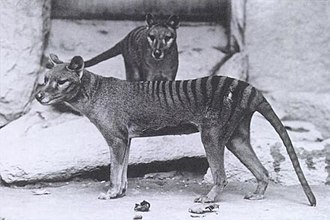
Its nickname came from the dark stripes across its back, which made it look similar to a tiger.
The animal had a dog-like body, a stiff tail, and a powerful jaw that could open unusually wide.
A Tragic End
The Tasmanian Tiger once lived across Australia and Tasmania.
However, after European settlement, it was heavily hunted.
Farmers believed it was killing livestock and bounties were offered for every animal killed.
Combined with habitat loss and disease, the population declined rapidly.
The last known Tasmanian Tiger died in captivity in 1936.
The Sightings That Never Stopped
Most extinct animals disappear from public attention.
The Tasmanian Tiger did not.
For decades, people have reported sightings from remote forests and wilderness areas.
Some witnesses claim to have seen striped animals matching its description.
Others have reported unusual tracks or brief encounters.
However, none of these sightings have been officially confirmed.
Tasmanian Tiger — Officially extinct since 1936, yet still the subject of countless reported sightings. Source: Wikimedia Commons
Why Scientists Keep Looking
The possibility of rediscovery keeps interest alive.
History has shown that some animals thought extinct have later been found again.
Remote areas of Australia still contain vast stretches of wilderness that remain difficult to explore.
Because of this, some researchers believe there is a small chance that a hidden population could exist.
Modern Searches
Today, searches use advanced technology.
Researchers deploy:
- Camera traps
- Drones
- Motion sensors
- DNA analysis
Despite years of searching, no conclusive evidence has been found.
Still, the search continues.
Why It Matters
The story of the Tasmanian Tiger is a reminder of how easily species can disappear.
It also highlights the importance of protecting wildlife before populations reach a critical point.
Even if the Tasmanian Tiger is truly gone, its story continues to inspire conservation efforts around the world.
Conclusion
The Tasmanian Tiger remains one of the greatest wildlife mysteries of modern times.
Perhaps it vanished forever in 1936.
Or perhaps somewhere deep in the wilderness, a few still survive unseen.
Until definitive proof is found, the mystery will continue.
Sources: Wikipedia, National Museum Australia, Australian Museum

0 Comments